


Description
PrymaLab · Research Use Only
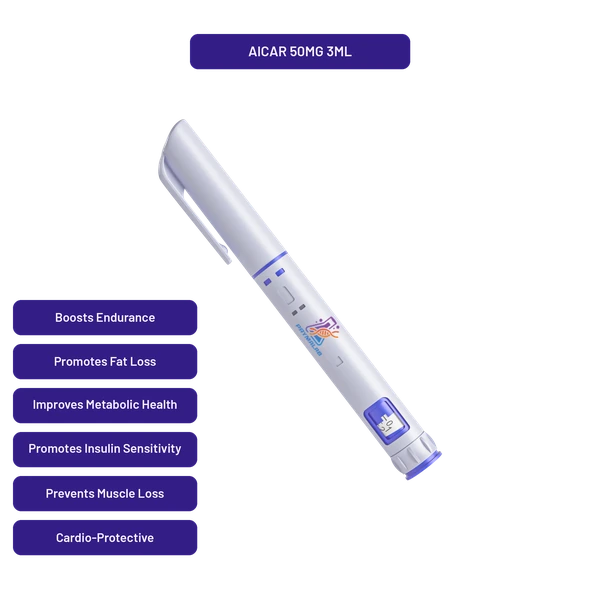
Preloaded Autoinjector | AICAR | 3ml Pen | 50mg
Acadesine nucleoside in solution · 3ml at 16.67mg/ml · No reconstitution step
The aicar pen is a preloaded 3ml research autoinjector holding 50mg of acadesine in solution at 16.67mg/ml, which is 64.5 mM at a molecular weight of 258.23 g/mol. AICAR is a nucleoside rather than a peptide, so the risk in a filled cartridge is not degradation chemistry but a solubility ceiling that cold storage pushes the solution toward.
Specification Table
| Property | Value |
|---|---|
| Device format | Preloaded autoinjector pen, glass cartridge |
| Fill volume | 3 ml |
| Concentration | 16.67 mg/ml |
| Total compound in device | 50 mg |
| Molar concentration | 64.5 mM (64,500 µM) |
| Compound | Acadesine (AICA riboside), the nucleoside sold as AICAR. Not a peptide |
| CAS number | 2627-69-2 (acadesine, the riboside). The intracellular monophosphate ZMP is a different substance, CAS 3031-94-5 |
| Molecular formula | C9H14N4O5 |
| Molecular weight | 258.23 g/mol (PubChem CID 17513) |
| Structure | 5-aminoimidazole-4-carboxamide-1-beta-D-ribofuranoside: an aminoimidazole carboxamide base on a ribose sugar, with no phosphate |
| Solution appearance | Not published on the product record. An intact solution is clear and colourless with no crystals |
| Reconstitution required | None. Supplied as solution |
| Solubility ceiling | Approximately 25 to 30 mg/ml in water at room temperature (about 100 mM), commonly cited and not confirmed against a peer-reviewed source |
| Fill against that ceiling | 16.67 mg/ml is roughly 55 to 67% of saturation at room temperature, and cold storage lowers the ceiling further |
| Crystallisation risk | Genuine. Nucleosides of this type crystallise readily; inspect for haze or crystals before every draw |
| Excipient system | Not published on the product record. Confirm against certificate of analysis |
| Solution pH | Not published on the product record. Neutral is preferable; pH extremes accelerate hydrolysis |
| Storage | 2-8°C, protected from light. Do not freeze |
| Light sensitivity | Modest. The aminoimidazole carboxamide chromophore absorbs in the ultraviolet; oxidation is not the dominant route |
| Solution stability | Not established over device shelf life. No forced-degradation study for an acadesine solution was located |
| Adsorption | Negligible. Small, polar and near-neutral, unlike the peptides in this category |
| Purity | Per lot-specific certificate of analysis |
| Regulatory status | No approved product in any jurisdiction. On the WADA Prohibited List since 2009 under hormone and metabolic modulators |
Why AICAR Is Not a Peptide, and Why That Changes Everything
Every degradation route that dominates the rest of this product category is absent here, because acadesine has no amide backbone, no side chains, no cysteines and no chain to fold: it is a 258.23 g/mol nucleoside, a base joined to a ribose sugar.
The distinction matters on a page like this because the checklist changes completely. Deamidation needs an asparagine. Disulfide scrambling needs cysteines. Fibrillation needs a polypeptide chain that can stack into a beta sheet. Diketopiperazine formation needs an N-terminal dipeptide. Adsorption to glass needs a charged amphiphile. None of those apply to a small polar molecule, which is why the definition of what counts as a peptide is worth settling before a stability discussion starts.
There is a second identity point, and vendor listings get it wrong routinely. What is sold as AICAR is acadesine, the ribonucleoside, CAS 2627-69-2, 258.23 g/mol, with no phosphate group. The AMP-mimicking species that activates AMP-activated protein kinase is ZMP, the ribonucleotide, CAS 3031-94-5, 338.21 g/mol, and it exists only inside a cell after adenosine kinase adds the phosphate. Two substances, two CAS numbers, an 80 Da difference. A certificate reporting 338.21 describes something the cartridge does not contain, and a listing that calls the material a ribonucleotide is describing the wrong molecule.
What Changes When AICAR Ships in Solution?
The dominant risk is physical rather than chemical: at 16.67 mg/ml the fill sits at roughly 55 to 67% of acadesine’s commonly cited room-temperature aqueous solubility of 25 to 30 mg/ml, and refrigeration lowers that ceiling, so crystallisation inside the aicar pen is the failure mode to watch.
The arithmetic is worth spelling out because it is the whole argument. A ceiling of 25 to 30 mg/ml is about 100 mM. The fill is 64.5 mM. That is not a saturated solution at room temperature, and it is also not a comfortable margin. Solubility of small nucleosides falls with temperature, and a device stored at 2-8°C for weeks is held under exactly the condition that reduces the ceiling. Nucleosides of this class also nucleate readily, so once a single crystal forms in a cartridge it provides a seed for more. The solubility figure itself could not be confirmed against a peer-reviewed source in the research for this page, which is a reason to treat the margin as smaller than it looks rather than larger.
The practical consequence is unusual for this category. A precipitated device is not a degraded device; the molecule in the crystals is unchanged. It is an under-strength device, because the concentration in the liquid phase has dropped to the saturation value while the label still says 16.67 mg/ml. That failure produces a quiet, systematic negative bias in every subsequent draw, and no purity assay run on redissolved material will show anything wrong.
Chemical degradation exists but runs slowly. The glycosidic bond joining base to ribose and the carboxamide on the imidazole ring are both hydrolysable, and both accelerate at pH extremes, which is why a neutral formulation is the sensible one and why an unpublished pH is a real gap. Photo-oxidation is not the dominant route; the chromophore absorbs in the ultraviolet and light protection is prudent rather than critical. Adsorption, the quiet loss route for peptides in this catalogue, is negligible for a small polar molecule with no net charge to speak of.
No dedicated forced-degradation study for an acadesine solution was located in the peer-reviewed literature, and no approved product exists whose formulation could be used as a precedent. Acadesine was developed as an intravenous agent and was never marketed, so there is no prescribing information with an excipient list to cite.
AICAR 50mg in 3ml: What Does Each Increment Carry?
Fifty milligrams in 3 ml is 16.67 mg/ml, which is 64.5 mM, so a 0.01 ml increment carries 167 micrograms (0.645 micromoles) and a 0.1 ml increment carries 1.67 mg (6.45 micromoles).
Those figures assume a 0.01 ml graduation, the common insulin-pattern value, and the resolution of this specific aicar pen is not stated on the product record. The peptide calculator recomputes for any other graduation. The aicar 50mg fill is also the reason the increment mass is large compared with the rest of this category: a small molecule at a high molar concentration puts far more substance into the same volume than a 4 kDa peptide does.
Against the published work the stock is concentrated but not absurdly so, which is unusual here. In vitro AMPK studies typically work at 0.1 to 2 mM, the range used by Corton 1995 and Merrill 1997, so a 64.5 mM solution is roughly 30 to 600 times above the working concentration rather than the million-fold gap that separates a peptide pen from a receptor assay. A single 0.01 ml increment diluted into 10 ml of medium lands near 65 micromolar. Rodent studies dosed by body weight, hundreds of mg/kg intraperitoneally in Narkar 2008, so there is no published concentration to match against a fixed-strength device.
AICAR Pen vs Vial: What Does the Format Suit?
The aicar pen vs vial decision is not the usual one, because a solid does not adsorb, does not aggregate and does not hydrolyse: a lyophilized vial stops the clock outright, while an aicar pen holds a solution sitting at two thirds of its solubility ceiling for the whole of its shelf life.
What the pen buys is consistency and convenience. Every draw comes from one solution prepared once, which removes weighing error, dissolution time and the temptation to make up a stock at whatever concentration is handy. For work that needs many equal draws over weeks, that is worth something real. The general trade is covered in the pen versus vial article and on the preloaded autoinjector category page, which lists the fields to confirm before ordering any device: fill date, verified concentration, buffer and pH, graduation resolution, cartridge material and cold-chain history.
What the vial buys is control over concentration, and for this compound that is the stronger argument. The lyophilized AICAR 50mg vial can be dissolved at 5 mg/ml, far below any solubility limit, or at 25 mg/ml on the day it is needed, and either way the crystallisation question never arises. A dry solid also carries no pH, so the hydrolysis clock has not started. AICAR solution vs lyophilized is, for once, a question with a defensible technical answer rather than a preference.
Verifying the AICAR Pen Before Use
Hold the aicar pen up to a light against a dark background and look for crystals as well as haze: for this compound the informative inspection is for a solid phase, and a needle or plate crystal at the bottom of a cartridge means the liquid above it is at saturation rather than at label strength.
Warming the device to ambient temperature before actuating serves two purposes here rather than one. Cold solution is more viscous, and spring-driven mechanisms deliver less volume against a viscous load. Cold solution is also nearer its solubility limit, so allowing the device to equilibrate can redissolve material that came out during refrigerated storage. A device that still shows crystals after equilibration should not be treated as being at 16.67 mg/ml.
Content can be verified more easily than for the peptides in this category. Acadesine absorbs in the ultraviolet through its aminoimidazole carboxamide chromophore, with a maximum in the mid-260 nanometre region rather than at the 280 nm window used for tryptophan and tyrosine, so a diluted sample read against a reference standard gives a direct concentration. Reversed-phase HPLC separates acadesine from hydrolysis products, and it will also separate it from ZMP should a supplier have shipped the phosphate by error, since an 80 Da mass difference and a phosphate charge change both retention and mass. Gravimetric verification of delivered volume, actuating onto a tared vessel once per device, remains worth running.
What Does the Literature Report on AICAR Peptide Benefits?
The honest summary of aicar peptide benefits is that the famous result is a mouse result and the largest human trial was negative: Narkar 2008 reported improved running endurance in sedentary mice, while RED-CABG, a phase 3 trial in roughly 3,080 cardiac surgery patients, found no benefit.
The mechanistic work came first. Corton 1995 in the European Journal of Biochemistry established the compound as a way to activate AMP-activated protein kinase in intact cells and set out the route: the nucleoside enters through nucleoside transporters, is phosphorylated inside the cell to ZMP, and ZMP mimics AMP at the kinase. Merrill 1997 showed in rat muscle that this raised fatty-acid oxidation and glucose uptake. Narkar 2008 in Cell is the paper everything else is built on in popular accounts, describing the compound with a PPAR-delta agonist as an exercise mimetic and reporting improved endurance in untrained mice.
The human record points the other way. Newman 2012 in JAMA reported the RED-CABG trial, in which peri-operative acadesine did not reduce the composite of death, non-fatal stroke or severe left-ventricular dysfunction after coronary artery bypass grafting. That is a well-powered phase 3 study with a null result, and it is the largest body of human experience with this molecule. Campàs 2003 in Blood is the other line of human-relevant work, reporting AMPK-dependent apoptosis in B-cell chronic lymphocytic leukaemia cells while sparing normal T lymphocytes.
What has not been studied is the part that matters for anyone reading a pen listing. There is no controlled human trial of this compound for athletic performance, body composition or metabolic outcomes of any kind, no trial of a preloaded subcutaneous fixed-concentration device, and no established human dose outside the intravenous cardiac-surgery programme. Adverse findings in that programme amounted to a lack of efficacy rather than a toxicity syndrome, and high purine loading raises theoretical questions about uric-acid handling that the public literature does not settle.
AICAR Peptide vs MOTS-c: What Separates Them?
The aicar peptide vs mots c comparison is between two different classes of molecule: acadesine is a 258.23 g/mol nucleoside with no amino acids in it, while MOTS-c is a 16-residue mitochondrial-derived peptide, so their handling problems have nothing in common.
In a cartridge that difference is the whole story. A peptide brings side-chain chemistry, backbone hydrolysis, surface adsorption and the possibility of aggregation, and it needs to be kept away from interfaces and metals. A nucleoside brings none of those and brings a solubility ceiling instead. A storage protocol written for one is not a storage protocol for the other, and a supplier who has copied stability language across both is telling you something about the supplier.
The evidence bases differ as well, though both are thinner than the marketing around them. This compound has a phase 3 trial with a null result and a widely cited mouse endurance study. The regulatory positions are not interchangeable either: acadesine has been on the WADA Prohibited List since 2009, and any comparator should be checked against the current year’s list rather than assumed to share that status.
What Is the Safety and Regulatory Position?
Acadesine is approved nowhere and has been on the WADA Prohibited List since 2009, sitting under the hormone and metabolic modulators class as a metabolic modulator, which is the single most consequential fact for anyone framing research around sport.
The subsection number within that class is renumbered from year to year, so a citation should come from the current year’s list rather than from a secondary source. The compound was detected in professional cycling in 2009, which is the context in which it was added. It reached phase 3 for peri-operative cardioprotection and was never approved, so there is no marketed acadesine product in any jurisdiction.
In the United States it is not an approved active ingredient and is not appropriate for lawful human compounding; an injectable acadesine preparation sold for human use would be an unapproved new drug. No vendor solution has published identity, purity or stability data, and the trial experience described above was gathered with characterised material given intravenously under monitoring, which has no bearing on a research cartridge. The aicar pen is supplied for laboratory research only and must not be given to humans or animals.
Published Literature
Every entry here was opened at the publisher or in a primary index before it was listed. Every entry is about the compound itself. The delivery format has no published literature at all.
- Corton JM, Gillespie JG, Hawley SA, Hardie DG. European Journal of Biochemistry. 1995;229(2):558-565. DOI: 10.1111/j.1432-1033.1995.0558k.x PMID: 7744080
- Merrill GF, Kurth EJ, Hardie DG, Winder WW. American Journal of Physiology. 1997;273(6):E1107-E1112. DOI: 10.1152/ajpendo.1997.273.6.E1107 PMID: 9435525
- Campàs C, López JM, Santidrián AF, et al. Blood. 2003;101(9):3674-3680. DOI: 10.1182/blood-2002-07-2339 PMID: 12522004
- Narkar VA, Downes M, Yu RT, et al. Cell. 2008;134(3):405-415. DOI: 10.1016/j.cell.2008.06.051 PMID: 18674809
- Newman MF, Ferguson TB, White JA, et al. JAMA. 2012;308(2):157-164. DOI: 10.1001/jama.2012.7633 PMID: 22782417
Frequently Asked Questions
What is the aicar pen?
A preloaded 3ml research autoinjector holding 50mg of acadesine in solution at 16.67mg/ml, which is 64.5 mM. No reconstitution step is needed. AICAR is a nucleoside of 258.23 g/mol rather than a peptide. Supplied strictly for laboratory research; no approved acadesine product exists anywhere.
Is AICAR actually a peptide?
No. It is 5-aminoimidazole-4-carboxamide-1-beta-D-ribofuranoside, a nucleoside made of a base and a ribose sugar, with no amino acids and no amide backbone. That means deamidation, disulfide scrambling, fibrillation and surface adsorption, the routes that dominate peptide cartridges, do not apply.
What is the difference between acadesine and ZMP?
Acadesine is the nucleoside, CAS 2627-69-2, 258.23 g/mol, with no phosphate, and it is what this device contains. ZMP is the intracellular monophosphate, CAS 3031-94-5, 338.21 g/mol, formed after a cell phosphorylates the nucleoside. ZMP is the species that mimics AMP at the kinase.
What does aicar 50mg deliver per increment?
At 16.67 mg/ml, a 0.01 ml increment carries 167 micrograms, which is 0.645 micromoles, and a 0.1 ml increment carries 1.67 mg or 6.45 micromoles. The graduation resolution of this device is not stated on the product record and must be confirmed before those figures are applied.
Can the solution crystallise in the cartridge?
Plausibly, and that is the format-specific risk. At 16.67 mg/ml the fill is roughly 55 to 67% of the commonly cited room-temperature solubility of 25 to 30 mg/ml, and refrigeration lowers that ceiling. Nucleosides of this class nucleate readily, so one crystal seeds more.
What happens if crystals form?
The device becomes under-strength rather than degraded. The material in the crystals is chemically unchanged, but the liquid phase has dropped to its saturation concentration while the label still reads 16.67 mg/ml, which biases every subsequent draw downward. A purity assay on redissolved material shows nothing wrong.
Should the device be warmed before use?
Yes, for two reasons here. Cold solution is more viscous and spring-driven mechanisms deliver less volume against a viscous load. Cold solution is also nearer its solubility limit, so equilibrating to ambient temperature can redissolve material that came out during storage. Crystals that persist after warming are a stop signal.
Does this compound degrade chemically in water?
Slowly. The glycosidic bond joining base to sugar and the carboxamide on the imidazole ring are both hydrolysable, and both accelerate at pH extremes, so a neutral formulation matters. Photo-oxidation is not the dominant route. No forced-degradation study for an acadesine solution was located.
AICAR pen vs vial: which suits which work?
The vial has the stronger technical case for this compound, because a dry solid has no solubility ceiling and no hydrolysis clock, and it can be dissolved at whatever concentration the work needs. The pen buys consistency across many equal draws from a single solution prepared once under controlled conditions.
What is not stated on the product record?
The excipient system, the solution pH, the fill date and the graduation resolution. The pH matters because it sets the hydrolysis rate for the glycosidic bond and the carboxamide. Request all four from the lot certificate of analysis before quantitative work rather than after an unexpected result.
How can the contents be verified?
By ultraviolet absorbance and by chromatography. The aminoimidazole carboxamide chromophore absorbs with a maximum in the mid-260 nanometre region, so a diluted sample read against a reference standard gives a concentration directly. Reversed-phase HPLC separates the nucleoside from hydrolysis products and from the phosphate ZMP.
How does the fill compare with concentrations used in cell work?
Closely, by the standards of this category. In vitro AMPK studies typically use 0.1 to 2 mM (Corton 1995; Merrill 1997), so the 64.5 mM stock is about 30 to 600 times above them. One 0.01 ml increment diluted into 10 ml of medium lands near 65 micromolar.
What are the reported aicar peptide benefits in the literature?
In animals, improved running endurance in sedentary mice (Narkar 2008) and increased fatty-acid oxidation and glucose uptake in rat muscle (Merrill 1997). In humans, nothing positive: the phase 3 RED-CABG trial in roughly 3,080 cardiac surgery patients found no benefit (Newman 2012).
What did the largest human trial find?
Newman 2012 in JAMA reported that peri-operative acadesine did not reduce the composite of death, non-fatal stroke or severe left-ventricular dysfunction after coronary artery bypass grafting in roughly 3,080 patients. It is a well-powered phase 3 study with a null result and the largest human experience with this molecule.
What does the leukaemia work report?
Campàs 2003 in Blood reported that acadesine activates AMPK and induces apoptosis in B-cell chronic lymphocytic leukaemia cells while sparing normal T lymphocytes. That selectivity is unusual and is an in vitro finding. It is not a treatment claim and no approved indication follows from it.
Aicar peptide vs mots c: what is the difference?
Class. Acadesine is a 258.23 g/mol nucleoside with no amino acids; MOTS-c is a 16-residue mitochondrial-derived peptide. A peptide brings side-chain chemistry, adsorption and aggregation risk; a nucleoside brings a solubility ceiling. Storage language written for one does not transfer to the other.
Is AICAR banned in sport?
Yes. WADA added acadesine to the Prohibited List from 2009, under the hormone and metabolic modulators class as a metabolic modulator, after it was detected in professional cycling that year. The subsection number is renumbered annually, so cite the current year’s list rather than a secondary source.
Is there an approved acadesine product?
No. It reached phase 3 as an intravenous agent for peri-operative cardioprotection and was never approved, so no marketed product exists and there is no prescribing information whose excipients or pH could serve as a formulation precedent. In the United States it is not an approved active ingredient.
Compliance Statement
The AICAR autoinjector is sold exclusively for laboratory research use. It is not a drug, food, or cosmetic product, and it is not a dietary product of any kind. It is not approved by the FDA or any comparable authority for human or veterinary use. This product is not intended to diagnose, treat, cure, or prevent any disease. It must not be given to humans or animals. Purchase is restricted to qualified researchers and institutions operating within applicable laws. All handling is the responsibility of the purchasing laboratory.








Reviews
There are no reviews yet.